
Perception layer
Depth cameras for robotics
The camera decides what the policy can see. Wrist cameras and scene cameras are different jobs with different specifications — and the difference between them is where most rigs go wrong.
Before you spec anything
Start with the honest version
Most published imitation-learning work does not feed depth to the policy at all. ALOHA runs four plain RGB cameras — two static, two wrist-mounted. LeRobot ships a camera API with no recommended model. The exception is DROID, which uses two ZED 2 scene cameras and a ZED Mini on the wrist.
So depth earns its cost in calibration, grasp proposal and scene reconstruction — not usually as a policy input. Buy it for what it actually does, and be sceptical of anyone selling you depth as a training-data requirement.
Decision framework
Four questions that pick the camera
Q1
Wrist or scene?
A wrist camera has to focus at contact distance. Most depth cameras bottom out between 14 and 30 cm, which is further than the object you are gripping. This single number eliminates most of the market.
Q2
Is the base moving?
Rolling shutter on RGB is tolerable on a fixed rig and a real problem on a moving platform. If the robot drives, insist on global shutter across both sensors.
Q3
USB, PoE or GMSL2?
USB is fine on a bench and fragile on a chassis. PoE and GMSL2 survive cable runs and vibration. Getting this wrong is discovered during integration, not procurement.
Q4
Who is the end customer?
Orbbec is China-origin and offered to commercial and education customers only. If the programme serves defense or government, the shortlist narrows before any spec is compared.
Available now
In the catalog
Prices shown are indicative and exclude tax and freight. Quote-only lines are configured per project.
 Quote
Quote
RealSense
Intel RealSense D405 Depth Camera
The short-range depth camera used as a wrist camera in robot manipulation. Its 7 cm minimum range...
United StatesDepth Camera
Quote required
Get quote
 Quote
Quote
RealSense
Intel RealSense D435i Depth Camera
The standard third-person scene camera for tabletop manipulation. Global-shutter depth with an integrated IMU, and an...
United StatesDepth Camera
Quote required
Get quote
 Quote
Quote
RealSense
Intel RealSense D456 Depth Camera
The ruggedised long-range option for mobile robots. Global shutter on both depth and RGB — the...
United StatesDepth Camera
Quote required
Get quote
 Quote
Quote
Luxonis
Luxonis OAK-D Pro Depth Camera
Active stereo depth with on-camera AI inference and an IR dot projector, so it keeps depth...
United StatesDepth Camera
Quote required
Get quote
 Quote
Quote
Stereolabs
Stereolabs ZED X Nano Stereo Camera
The compact GMSL2 stereo camera for Jetson-based robots. GMSL2 is the right interface for a robot...
Depth Camera
Quote required
Get quote
 Quote
Quote
Orbbec
Orbbec Gemini 335 Depth Camera
Global-shutter stereo in the same class as a D435, at roughly half the cost, with a...
Commercial use onlyDepth Camera
Quote required
Get quote
 Quote
Quote
Orbbec
Orbbec Gemini 335Lg Depth Camera
The AMR-ready sibling of the Gemini 335: GMSL2 over FAKRA-Z, IP65, and global shutter on both...
Commercial use onlyDepth Camera
Quote required
Get quote
 Quote
Quote
Orbbec
Orbbec Femto Mega Depth Camera
A time-of-flight depth camera with onboard Jetson Nano processing and Power-over-Ethernet. PoE plus a hardware trigger...
Commercial use onlyDepth Camera
Quote required
Get quote
Origin
RealSense (Cupertino, California), Luxonis (Colorado) and Stereolabs are non-China vendors. Orbbec operates its Asia headquarters in Shenzhen and is offered to commercial and education customers only.
Note that company headquarters is not the same as country of manufacture. None of these vendors publishes a manufacturing location. For any TAA or Buy American requirement we request a country-of-origin certificate per SKU in writing before quoting.
Compare
| Camera | Origin | Job | Depth range | Shutter | Depth res / fps | IMU | Interface | Gov / defense |
|---|---|---|---|---|---|---|---|---|
| RealSense D405 | United States | Wrist | 7–50 cm ideal, 7 cm min | Global | up to 1280 × 720 | not published | USB 2 / 3.1 | Eligible |
| RealSense D435i | United States | Scene | 0.3–3 m ideal, ~28 cm min | Global depth, rolling RGB | 1280 × 720 @ 90 | Yes | USB-C 3.1 | Eligible |
| RealSense D456 | United States | Mobile | 0.6–6 m ideal, ~52 cm min | Global both | 1280 × 720 @ 90 | Bosch BMI085 | USB-C, IP65 | Eligible |
| Luxonis OAK-D Pro | United States | Mobile, on-camera AI | ~0.8–12 m ideal | Global mono | 1280 × 800 mono | BNO086 9-axis | USB 2 / 3, IP66 | Eligible |
| Stereolabs ZED X Nano | Not verified | Mobile, Jetson | Not published | Not published | Not published | not published | GMSL2 | Confirm on request |
| Orbbec Gemini 335 | China | Scene, cost-sensitive | 0.3–3 m ideal, 0.1 m min | Global depth, rolling RGB | 1280 × 800 @ 30 | 6-DoF | USB 3.0 Type-C, IP5X | Commercial only |
| Orbbec Gemini 335Lg | China | Mobile | 0.25–6 m ideal, 0.17 m min | Global both | 1280 × 800 @ 30 | not published | GMSL2 / FAKRA-Z, IP65 | Commercial only |
Specifications are as published by each manufacturer. Where a field reads “not published,” the vendor does not state it publicly — we request it in writing for your evaluation rather than estimate. Stock and lead times are confirmed at quote.
Who buys what
Three rigs, three answers
Manipulation rigs
The standard pairing is a D405 on the wrist and a D435i for the scene. Nothing else focuses at 7 cm, so the wrist position has no real substitute. Where budget matters across several stations, the Gemini 335 covers the scene role at roughly half the cost.
Mobile robots and AMRs
Global shutter on both sensors, a robot-grade connector, and an ingress rating. D456 for USB with IP65, Gemini 335Lg for GMSL2, ZED X Nano for Jetson platforms, OAK-D Pro where you want obstacle detection without adding a compute box.
Reproducing published datasets
If the programme extends DROID or fine-tunes on it, matching optics matters for calibration transfer — that means ZED. Ask us; those models are special-order rather than shelf stock.
Two things worth knowing before you commit to a platform
RealSense is now an independent company — RealSense, Inc., selling under licence from Intel. The product line is unchanged and the ROS 2 wrapper is actively maintained, but the flagship D585 Pro is not expected to ship until Q1 2027, so we would not stock a D455-class part deeply against it.
The Orbbec Femto line succeeds the discontinued Azure Kinect. If you are replacing Azure Kinect units we can source them, but we do not recommend building a new programme on iToF at 15 fps for robot control.
Not sure which camera the rig needs?
Tell us the robot, whether the base moves, and where the camera mounts. We will tell you the cheapest camera that does the job — including when the answer is a plain RGB camera you already own.
Rig infrastructure
Sync hubs, adaptors and tactile sensing
A multi-camera rig is only as good as its trigger. Sync hubs, adaptors and cables so every view exposes on the same frame.
 Quote
Quote
NVIDIA
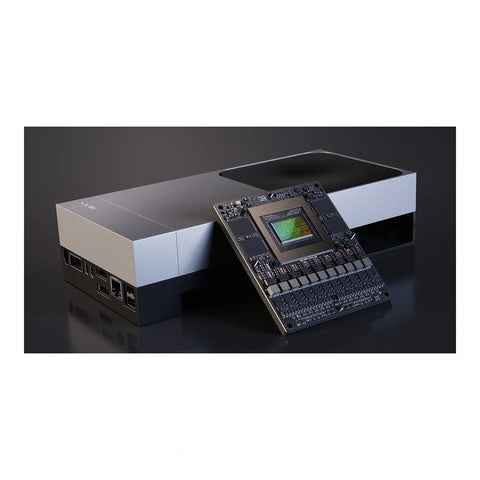
NVIDIA Jetson AGX Thor Developer Kit
The flagship on-robot compute for humanoid and multi-arm platforms. 2,070 FP4 TFLOPS and 128 GB of...
United StatesRobotics Compute
Quote required
Get quote
 Quote
Quote
NVIDIA
NVIDIA Jetson AGX Orin Developer Kit (64GB)
On-robot compute for a full-size rig. 275 TOPS and 64 GB of LPDDR5 is enough to...
United StatesRobotics Compute
Quote required
Get quote
 Quote
Quote
NVIDIA
NVIDIA DGX Spark
A deskside training box with 128 GB of coherent unified memory. In a robot-learning programme this...
United StatesRobotics Compute
Quote required
Get quote
 Quote
Quote
NVIDIA
NVIDIA Jetson Orin Nano Super Developer Kit
The entry point into on-robot inference. 67 TOPS in a 100 × 79 mm board at...
United StatesRobotics Compute
Quote required
Get quote
 Quote
Quote
Robotiq
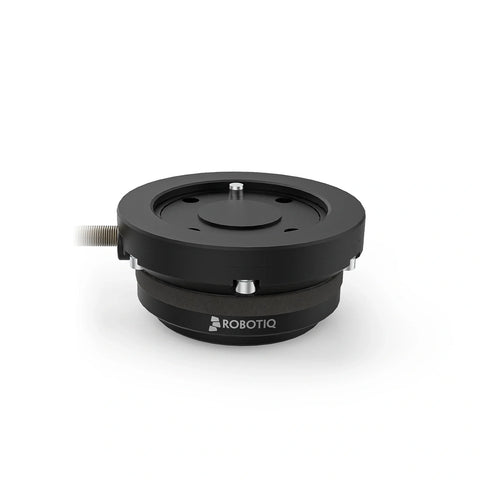
Robotiq FT 300-S Force Torque Sensor
A six-axis force/torque sensor that mounts at the wrist. If your arm is position-controlled and you...
CanadaForce & Tactile Sensor
Quote required
Get quote
 Quote
Quote
Orbbec
Orbbec Multi-Camera Sync Hub Pro
The part of a multi-camera rig nobody budgets for and every dataset needs. Without a common...
Commercial use onlyCapture Infrastructure
Quote required
Get quote
 Quote
Quote
Orbbec
Orbbec Multi-Camera Sync Hub Dev — Star
Star-topology trigger hub for a small rig — typically a three or four camera teleoperation cell....
Commercial use onlyCapture Infrastructure
Quote required
Get quote
 Quote
Quote
Orbbec
Orbbec Multi-Camera Sync Hub Dev — Daisy Chain
Daisy-chain trigger hub for rigs where cameras run along a rail or frame and star cabling...
Commercial use onlyCapture Infrastructure
Quote required
Get quote
 Quote
Quote
Orbbec
Orbbec Sync Adaptor — 8-Pin to RJ45
One adaptor per camera. This is the piece that connects a camera's 8-pin sync port to...
Commercial use onlyCapture Infrastructure
Quote required
Get quote
 Quote
Quote
Luxonis
Luxonis FSYNC Y-Adapter
Hardware frame sync for OAK cameras. Every device on the chain begins sensor exposure at the...
United StatesCapture Infrastructure
Quote required
Get quote
 Quote
Quote
XELA Robotics
XELA Robotics uSkin uSPa 44 Tactile Patch
Sixteen taxels in a patch smaller than a postage stamp, each reading three axes — shear...
JapanForce & Tactile Sensor
Quote required
Get quote
 Quote
Quote
XELA Robotics
XELA Robotics uSkin uSPa 46 Tactile Patch
The larger uSkin patch: 24 taxels across a 30.6 × 50.6 mm area at under 5...
JapanForce & Tactile Sensor
Quote required
Get quote
Talk to us
Spec a camera for your rig
The robot, the mount position, whether the base moves, and how many stations. We reply with a shortlist and a quote.
Form not loading? Request a quote.
Keep exploring
The rest of the robotics stack
Every layer, sourced and deployed by the same team.