
Operator interface
VR headsets for robotics data collection
A headset is the cheapest way to add an operator station. It is also the fastest way to scale demonstration collection from one rig to ten — provided you know what it can and cannot capture.
First, the limitation
What a headset cannot give you
Built-in hand tracking is good enough for gross manipulation and improving every release. It does not measure fingertip force, it does not detect slip, and it degrades under occlusion — exactly when the hand is wrapped around an object, which is exactly when the data matters.
So the honest framing is not headsets versus gloves. It is: headsets scale operator count cheaply, gloves raise the signal quality per demonstration. Most serious programmes run both — a small number of glove stations for contact-rich tasks, and a larger fleet of headset stations for volume.
In the catalog
Headsets we deploy for robotics
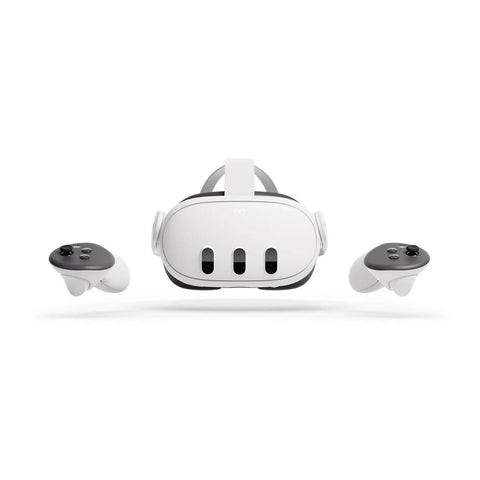
Meta
Meta Quest 3 - Business VR Headset
Powerful Mixed Reality for Work & Education Meta Quest 3 for Work and Education is a...
VR Headsets
$ 599.99excl. tax & freight
View
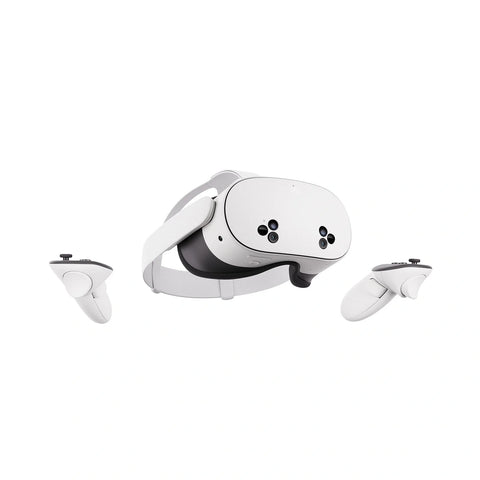
Meta
Meta Quest 3S - Business & Education VR Headset
Affordable Mixed Reality for Work & Education Meta Quest 3S is an accessible mixed reality solution...
VR Headsets
$ 349.99excl. tax & freight
View
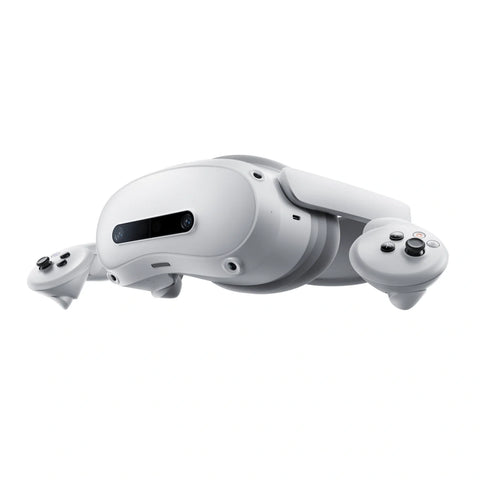
PICO
PICO 4 Ultra Enterprise (12GB + 256GB)
- Enterprise-grade VR headset - Designed for training, simulation, and collaboration - Supports scalable IT-managed deployments
VR Headsets
$ 899.00excl. tax & freight
View
PICO
PICO 4 Ultra Enterprise (16GB + 256GB)
- Enterprise-grade VR headset - Designed for training, simulation, and collaboration - Supports scalable IT-managed deployments
VR Headsets
$ 1,199.00excl. tax & freight
View
Compare
| Headset | Hand tracking | Passthrough | Eye tracking | Device management | Best for |
|---|---|---|---|---|---|
| Meta Quest 3 | ✓ | Colour | — | Meta Horizon Managed Services | Flagship operator station where visual fidelity matters |
| Meta Quest 3S | ✓ | Colour | — | Meta Horizon Managed Services | Fleet build-out, lowest cost per parallel station |
| PICO 4 Ultra Enterprise | Advanced | Colour | ✓ | Built-in enterprise MDM | IT-managed labs outside the Meta ecosystem |
Important for government and defense programmes
PICO products are offered to commercial and education customers only, and are not available for defense or government programmes — regardless of technical fit. If your programme has a government end customer, we will configure the operator stations on Meta Quest or another OpenXR-compatible headset.
Raise it at the consult stage and it costs you nothing; raise it after the purchase order and it costs you a re-spec.
Fleet
Ten stations is a logistics problem, not a hardware problem
One headset is an afternoon. Ten is device enrolment, a managed app deployment, per-station account hygiene, charging and hygiene rotation, spares, and a plan for the one that fails in week six. We provision headsets in Glendale before they ship — enrolled, updated, app-loaded, labelled and inventoried against your asset register — so the box you open is a working station.
What provisioning covers
Enrolled & updated
Device management configured, OS and firmware current, your application pre-loaded.
Labelled & inventoried
Asset tags matched to your register, serials reported back in a spreadsheet you can actually use.
Kitted
Straps, cables, charging, cases and hygiene consumables specified for the rotation you actually run.
Supported
Knox XR Support+ handles RMA and replacement so a dead headset does not stop a collection week.
Configuring a data collection fleet?
Tell us how many parallel stations and what the operators are doing. We will spec the headsets, the provisioning, and the spares ratio.
Talk to us
Tell us what you are building
Send us the task, the robot platform and your timeline. We reply with a configured bill of materials and a quote — usually within one business day.
Form not loading? Request a quote.
Keep exploring
The rest of the robotics stack
Every layer, sourced and deployed by the same team.