
Teleops Stations
Three station types on one axis
Fidelity up, scalability down. Each tier produces a kind of data the tier below structurally cannot — so the right question is not which is best, it is which signal your policy actually needs.
Where teleoperation sits
Why the top of this ladder is empty
Manipulation data comes from four places, roughly in order of cost: web video, simulation, egocentric capture worn by people, proxy devices like a gripper on a stick — and teleoperation on the robot’s own embodiment, which is the richest form of collection.
Everyone crowds the scalable end. Video and simulation are cheap and infinite, but neither can capture force, and the embodiment gap breaks transfer — a policy trained on a human hand does not run on a two-finger gripper. The high-fidelity corner sits nearly empty only because robots are not deployed at scale yet. Every robot that ships creates demand for tailored, contact-rich data — and that data can only come from a station like these.
The fidelity map
Where the data comes from
Everyone crowds the scalable end. Video and simulation cannot capture force, and the embodiment gap breaks transfer.
Other data sources
Station 1 · Base
Station 2 · Humanoid
Station 3 · Force Lab
The top rung is not experimental
Station 3 mirrors the setup Google DeepMind (London) and RAI Institute (Boston) independently run for contact-rich manipulation research. It is an established configuration, not a bet.
Configurations
The three stations
Station 1
Base
VR + arms
Data out
Task episodes — video, hand pose, arm joint trajectories, gripper state, time-synced and QA’d. Kinematics only, no force signal.
Good for
High-volume manipulation demos: pick-and-place, sorting, packing. Testing and comparing setups before you commit.
Typical kit
- VR headset with tracking
- Two position-controlled arms
- Dexterous hands or grippers
- Clutch-pedal teleop stack
- Swappable task cells — shelf, tabletop, bin
Station 2
Humanoid
Mocap suit + full humanoid
Data out
Full-body kinematics — gait, reach and manipulation in one stream, retargeted to your target humanoid.
Good for
Humanoid programmes: whole-body tasks, mobile manipulation, and human-motion pretraining matched to a specific robot.
Typical kit
- Xsens Link full-body suit
- Humanoid platform, or bring your own
- SenseGlove R1 or MANUS gloves
- Dexterous hands
- Staged environments + retargeting stack
Station 3
Force Lab
Torque-controlled leader-follower
Data out
Torque profiles, contact force, compliance and per-finger pressure alongside full video and kinematics. Force-true demonstrations.
Good for
Contact-rich, fragile and deformable tasks: gripping without crushing, cloth handling, insertion and assembly.
Typical kit
- Torque-controlled leader-follower pair
- SenseGlove R1 haptics
- TESOLLO DG-5F with fingertip force sensors
- Licensed mapper + integration pipeline
- Contact-rich task cells
Side by side
What each tier gives you
| 1 · Base | 2 · Humanoid | 3 · Force Lab | |
|---|---|---|---|
| Kinematics | ✓ | ✓ | ✓ |
| Video, time-synced | ✓ | ✓ | ✓ |
| Full-body gait + reach | — | ✓ | partial |
| Retargeted to a specific humanoid | — | ✓ | — |
| Torque & contact force | — | — | ✓ |
| Compliance / per-finger pressure | — | — | ✓ |
| Episodes per operator-day | Highest | Medium | Lowest |
| Relative cost per episode | Lowest | Medium | Highest |
| Government / defense eligible | Configuration-dependent | Configuration-dependent | Yes, by construction |
A note on eligibility
Several strong components in Stations 1 and 2 are China-origin and are offered for commercial use only. If your programme serves a defense or government end customer, tell us at the consult stage — we will configure around it. Station 3 is built entirely from non-China vendors, which is why it is the default for those programmes.
Not sure which rung you need?
Describe the task and the robot. We will tell you the cheapest station that produces the signal your policy actually needs — including if that is the bottom one.
Leader devices
Leader arms and teleop controls
The operator side of a station. Leader arms, bimanual kits and clutch controls that drive the follower and record the demonstration.
 Quote
Quote
Trossen Robotics
Trossen WidowX Leader Arm
The operator side of a leader-follower rig, sold on its own. The arm the human moves;...
United StatesLeader Arm
Quote required
Get quote
Quote
Knoxlabs
Clutch Pedal Teleop Control
Foot-operated engage and disengage for a teleoperation rig. The operator’s hands stay on the leader device,...
Teleop Control
Quote required
Get quote
 Quote
Quote
Franka
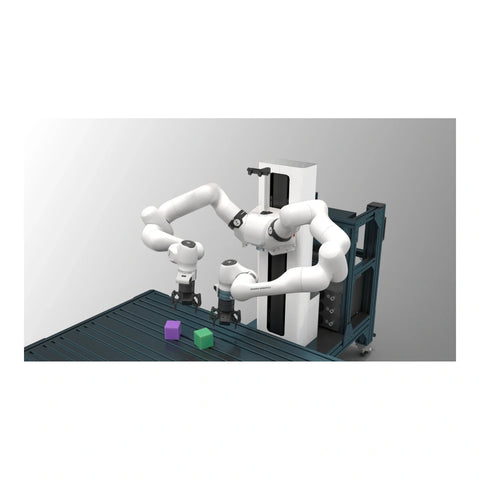
Franka Torque-Controlled Leader-Follower Pair
The platform behind our Force Lab station. Torque control on both sides means the rig captures...
GermanyLeader Arm
Quote required
Get quote
 Quote
Quote
Haption
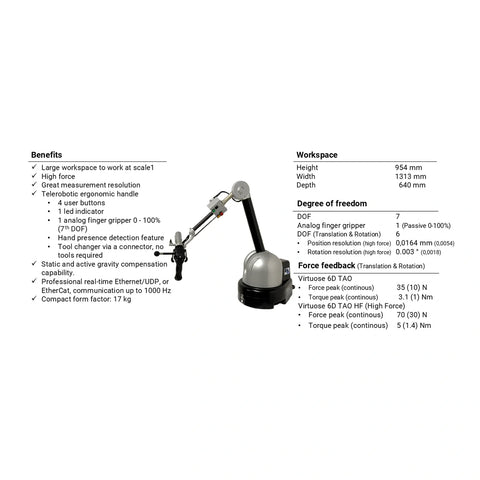
Haption Force-Feedback Leader Device
The high-end operator interface for the Force Lab configuration. Returns contact force to the operator’s hand...
FranceLeader Arm
Quote required
Get quote
 Quote
Quote
Knoxlabs
SO-101 Leader & Follower Arm Pair
The open-hardware leader-follower pair that the LeRobot framework is documented against — the lowest-cost entry point...
Leader Arm
Quote required
Get quote
 Quote
Quote
Trossen Robotics
Trossen AI Bimanual Teleoperation Kit
The bimanual leader-follower configuration that imitation-learning programmes collect data on. An operator drives two leader arms;...
United StatesLeader Arm
Quote required
Get quote
Infrastructure
Compute, sync and tactile sensing
The parts of a station that do not appear in the photo: on-robot compute, multi-camera frame sync, and the tactile channels that make contact-rich data usable.
 Quote
Quote
NVIDIA
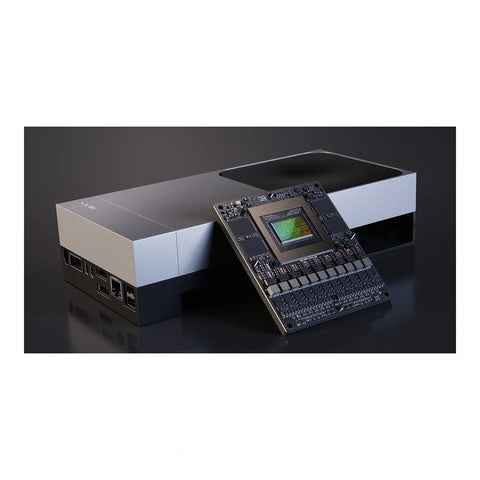
NVIDIA Jetson AGX Thor Developer Kit
The flagship on-robot compute for humanoid and multi-arm platforms. 2,070 FP4 TFLOPS and 128 GB of...
United StatesRobotics Compute
Quote required
Get quote
 Quote
Quote
NVIDIA
NVIDIA Jetson AGX Orin Developer Kit (64GB)
On-robot compute for a full-size rig. 275 TOPS and 64 GB of LPDDR5 is enough to...
United StatesRobotics Compute
Quote required
Get quote
 Quote
Quote
NVIDIA
NVIDIA DGX Spark
A deskside training box with 128 GB of coherent unified memory. In a robot-learning programme this...
United StatesRobotics Compute
Quote required
Get quote
 Quote
Quote
NVIDIA
NVIDIA Jetson Orin Nano Super Developer Kit
The entry point into on-robot inference. 67 TOPS in a 100 × 79 mm board at...
United StatesRobotics Compute
Quote required
Get quote
 Quote
Quote
Robotiq
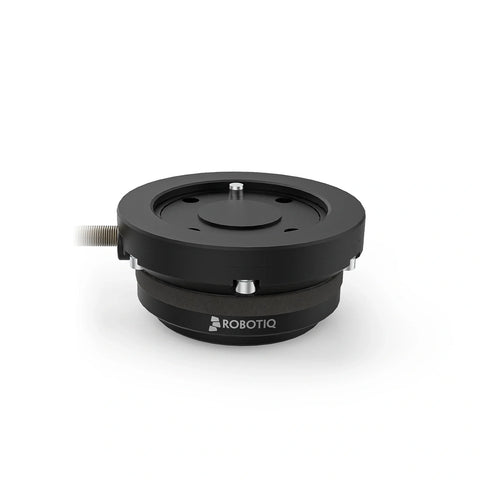
Robotiq FT 300-S Force Torque Sensor
A six-axis force/torque sensor that mounts at the wrist. If your arm is position-controlled and you...
CanadaForce & Tactile Sensor
Quote required
Get quote
 Quote
Quote
Orbbec
Orbbec Multi-Camera Sync Hub Pro
The part of a multi-camera rig nobody budgets for and every dataset needs. Without a common...
Commercial use onlyCapture Infrastructure
Quote required
Get quote
 Quote
Quote
Orbbec
Orbbec Multi-Camera Sync Hub Dev — Star
Star-topology trigger hub for a small rig — typically a three or four camera teleoperation cell....
Commercial use onlyCapture Infrastructure
Quote required
Get quote
 Quote
Quote
Orbbec
Orbbec Multi-Camera Sync Hub Dev — Daisy Chain
Daisy-chain trigger hub for rigs where cameras run along a rail or frame and star cabling...
Commercial use onlyCapture Infrastructure
Quote required
Get quote
 Quote
Quote
Orbbec
Orbbec Sync Adaptor — 8-Pin to RJ45
One adaptor per camera. This is the piece that connects a camera's 8-pin sync port to...
Commercial use onlyCapture Infrastructure
Quote required
Get quote
 Quote
Quote
Luxonis
Luxonis FSYNC Y-Adapter
Hardware frame sync for OAK cameras. Every device on the chain begins sensor exposure at the...
United StatesCapture Infrastructure
Quote required
Get quote
 Quote
Quote
XELA Robotics
XELA Robotics uSkin uSPa 44 Tactile Patch
Sixteen taxels in a patch smaller than a postage stamp, each reading three axes — shear...
JapanForce & Tactile Sensor
Quote required
Get quote
 Quote
Quote
XELA Robotics
XELA Robotics uSkin uSPa 46 Tactile Patch
The larger uSkin patch: 24 taxels across a 30.6 × 50.6 mm area at under 5...
JapanForce & Tactile Sensor
Quote required
Get quote
Talk to us
Tell us what you are building
Send us the task, the robot platform and your timeline. We reply with a configured bill of materials and a quote — usually within one business day.
Form not loading? Request a quote.
Keep exploring
The rest of the robotics stack
Every layer, sourced and deployed by the same team.