

March 2026 – PICO has officially introduced its next-generation operating system, PICO OS 6, alongside an early preview of its upcoming flagship XR headset, internally codenamed Project Swan, targeting a global launch in late 2026.
PICO OS 6 represents more than an iterative update. It is a structural redesign of the spatial operating system, built to enable seamless coexistence between 2D applications, immersive 3D content, virtual environments, and mixed reality layers within a single unified workspace.
To fully realize this new computing paradigm, PICO plans to pair the operating system with upgraded hardware in 2026 under the Project Swan initiative.
Three principles behind OS 6: PICO frames the new OS around efficiency (true multitasking), intuition (natural interaction + UI that adapts), and openness (multiple ecosystems treated as first-class citizens).
PICO Spatial Engine: Unified Rendering at the OS Level
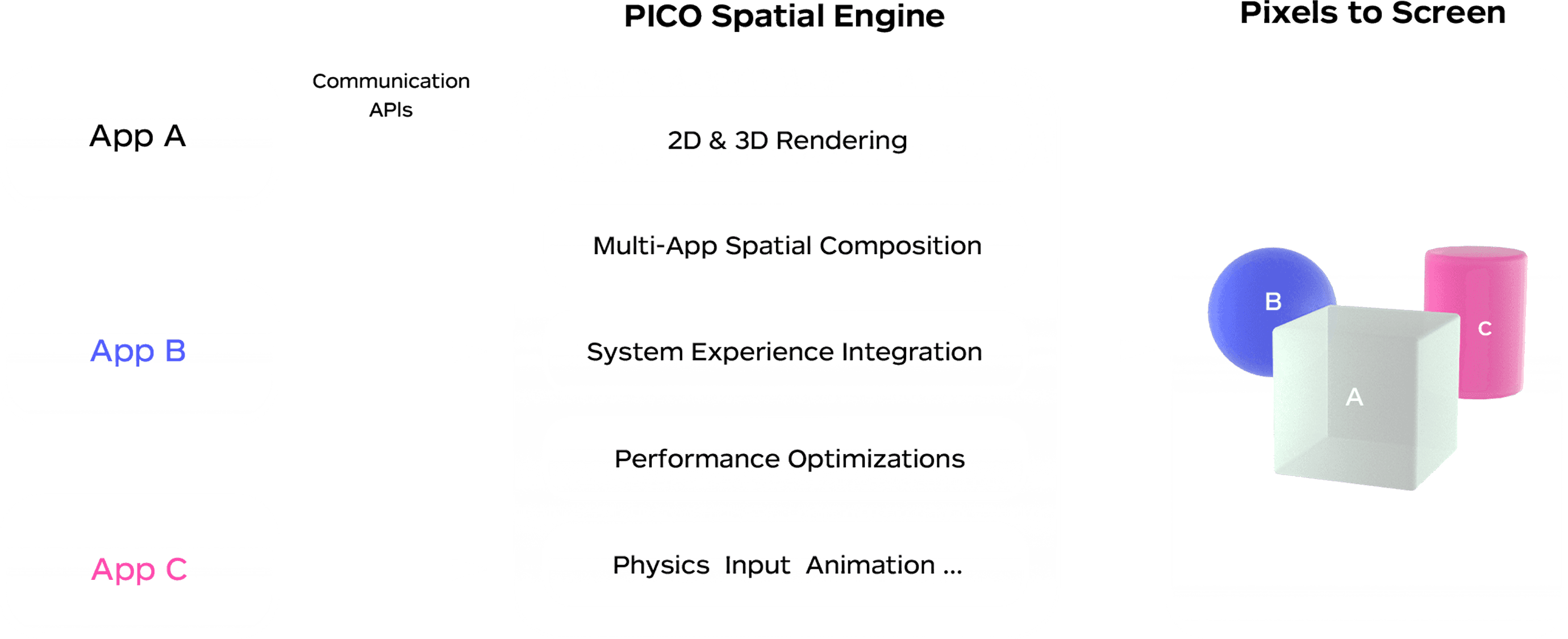
At the core of PICO OS 6 is the PICO Spatial Engine, a rebuilt rendering architecture that shifts graphical processing from individual applications to the operating system layer.
This unified approach enables:
- Simultaneous rendering of 2D apps, 3D objects, and physical passthrough
- Smoother multitasking across spatial windows
- Increased responsiveness and visual consistency
- Improved blending between digital and real-world environments
The key idea: instead of each app owning its own rendering pipeline, the OS acts as the “conductor,” dynamically allocating CPU/GPU resources so multiple 2D and 3D experiences can coexist while staying responsive.
Redefining Productivity: Spatial Multitasking
Built on the Spatial Engine, PICO OS 6 introduces advanced spatial multitasking capabilities — closer to “app coexistence” than simple app switching.
Users can:
- Collaborate on complex 3D models while keeping browser windows and notes active
- Utilize keyboard and mouse input for productivity workflows
- Switch between hand gestures, controllers, and traditional peripherals
- Operate in mixed reality without breaking application continuity
Example shown: a 3D tabletop experience running with friends as avatars, while 2D apps remain open and floating above a real desk — enabled by OS-level rendering.
Breaking Down Barriers: An Open Ecosystem
PICO OS 6 is designed around openness and cross-platform compatibility.
The system supports:
- Spatial-native applications
- OpenXR
- WebXR
- Android applications
- Web-based apps
- PC VR streaming
PICO also emphasized compatibility with its existing library — with prior PICO apps and games expected to remain supported and perform better on the new system.
Natural Interaction + New UI Design Language
PICO OS 6 expands input flexibility across use cases: eye-and-hand “look and pinch” interactions, controllers and motion trackers for 3D workflows, and keyboard/mouse support for productivity. PICO also introduced a new visual design language called Cloud Crystal, aimed at keeping UI readable and visually integrated with real environments as lighting conditions change.
Empowering Developers: Tools Available Now
PICO has introduced a comprehensive developer toolkit for OS 6, including:
- PICO Spatial SDK (Kotlin) with a declarative UI framework
- Component-based spatial UI system (with design guidelines and UI components)
- Android Studio integration (plugin + editor workflow)
- Desktop-based PICO Emulator (build/test without a headset)
- WebSpatial (open-source framework using HTML, CSS, React)
- Unity / Unreal / OpenXR support (including MR apps running alongside other windows)
Spatial UI that adapts
OS-level handling for lighting/material adaptation, readability, and common spatial UI patterns — reducing “environment-specific tuning.”
MR foundations baked in
Scene understanding capabilities were highlighted, including semantic labeling, meshing, plane detection, and persistent spatial anchoring.
The takeaway: PICO is packaging “multi-app spatial computing” not only as an OS feature, but as a developer platform — across native, web, and game engine workflows.
Project Swan: Hardware Built for the Next Phase
While PICO OS 6 lays the software foundation, Project Swan represents the hardware evolution required to unlock its full potential.
According to PICO’s preview, Project Swan is expected to feature:
- Next-generation MicroOLED displays approaching 4000 PPI
- Average 40 PPD, with center sweet spot exceeding 45 PPD
- Dual-chip architecture for mixed reality processing
- Custom XR silicon managing sensor fusion and perception
- Approximately 12ms latency in mixed reality pipeline
- Flagship SoC delivering more than 2× CPU and GPU performance over XR2 Gen 2
Positioning signal: PICO framed Swan around monitor-replacement clarity (PPD) and a faster MR pipeline (custom silicon + dual-chip design).
The combination of higher pixel density and mixed reality processing aims to position Project Swan for professional workflows, enterprise training, and productivity use cases.
What This Means for Enterprise XR
For organizations evaluating PICO hardware today — including the PICO 4 Ultra Enterprise — this announcement signals a clear long-term roadmap.
At Knoxlabs, we support PICO deployments across procurement, provisioning, MDM integration, asset management, and lifecycle support.
Explore PICO solutions:
https://www.knoxlabs.com/collections/picoxr
Flagship enterprise VR headset:
http://knoxlabs.com/products/pico4-ultra-enterprise
XR services and deployment support:
https://www.knoxlabs.com/pages/xr-services
Complete XR solutions overview:
https://www.knoxlabs.com/pages/xr-products
Request a consultation or custom quote:
https://www.knoxlabs.com/pages/quote
Looking Ahead
PICO has also launched a Global Early Access Program to gather technical feedback from experienced users as OS 6 and Project Swan move toward release.
As spatial computing matures, operating system architecture and deployment infrastructure will matter as much as hardware specifications.
The next phase of XR will not be defined by resolution alone — but by stability, scalability, and real-world usability.
For teams planning pilots or preparing for scaled deployments, now is the time to evaluate roadmap alignment and infrastructure readiness.